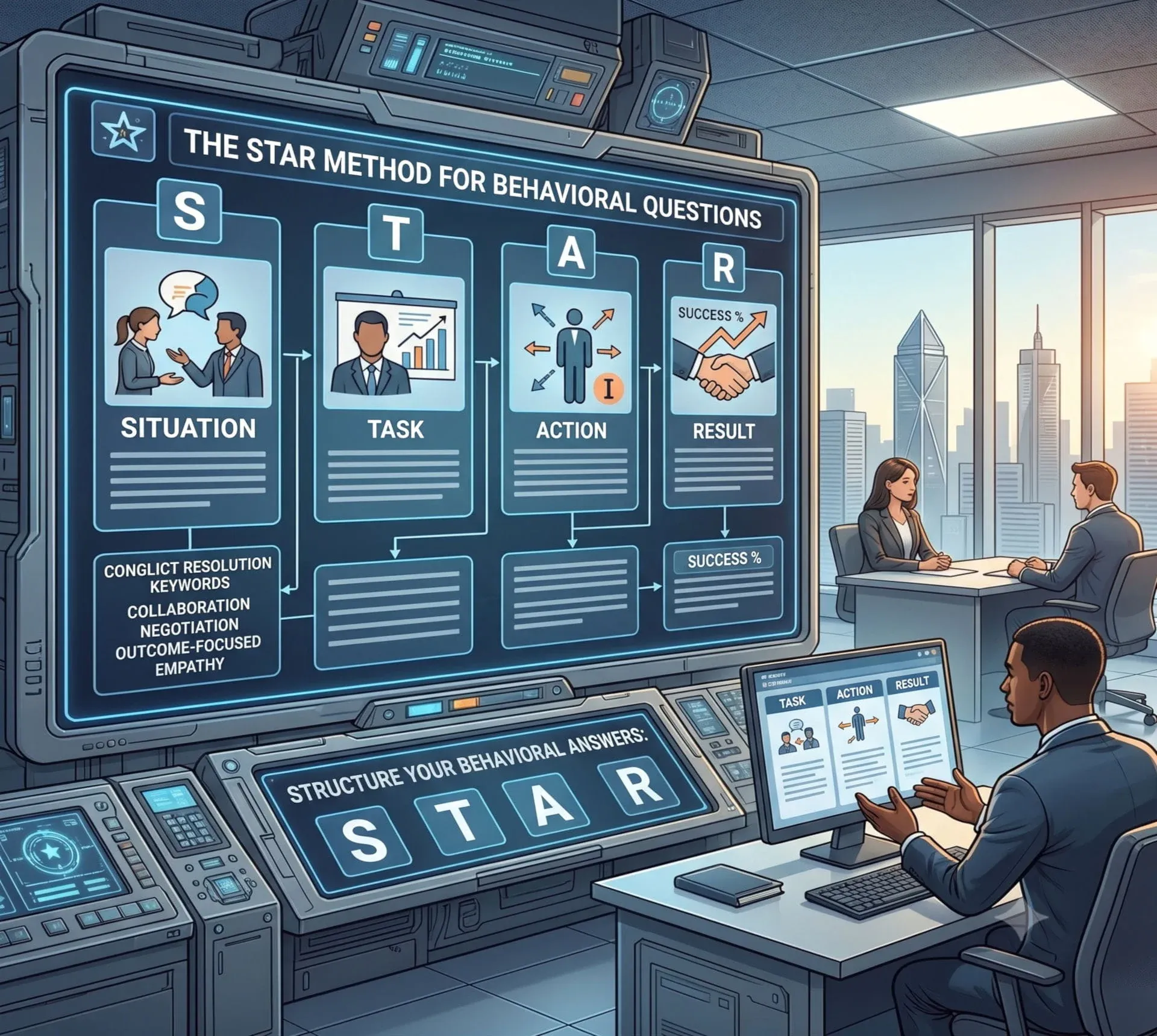
"Tell me about a time you dealt with conflict." Behavioural questions catch more candidates off guard than any technical question. The STAR method gives you a repeatable structure to answer clearly, under pressure, every time.
What STAR stands for
- Situation — set the scene briefly: where, when, what was at stake.
- Task — what were you specifically responsible for?
- Action — what did you personally do? (Not "we" — "I.")
- Result — what happened, ideally with a number or outcome attached.
Why interviewers ask this way
Behavioural questions exist because past behaviour is a far better predictor of future performance than a hypothetical answer. Questions like "describe a time you missed a deadline" or "tell me about a difficult colleague" are designed to see how you actually handled real pressure — not how well you can theorise about handling it.
A worked example
"Tell me about a time you had to meet a tight deadline." — Situation: "In my previous retail role, our regional stocktake had to be completed two days early because of an unannounced audit." Task: "As shift supervisor, I was responsible for coordinating the count across three departments with the same staff we had for a normal week." Action: "I split the team into paired counting stations, built a shared checklist so nothing was counted twice, and flagged discrepancies to management in real time instead of waiting until the end." Result: "We completed the stocktake a full day ahead of the deadline with a variance of under 0.5%, and management adopted the paired-counting approach for future audits."
Build a story bank before the interview
Don't improvise STAR answers live — prepare six to eight real stories in advance that can flex to cover common competency themes: teamwork, conflict resolution, failure or mistakes, leadership without authority, working under pressure, and using your own initiative. Most behavioural questions are a variation on these themes, so one well-prepared story about a stocktake, a difficult client, or a missed deadline can answer several different questions.
Key takeaways
- Structure every behavioural answer as Situation, Task, Action, Result — in that order.
- Use "I" for the Action step, even if you worked in a team.
- Prepare 6–8 real stories in advance rather than inventing answers on the spot.